
drone fell in water repair
Drone Fell in Water? Complete 2026 Guide — Can It Be Repaired?
Drone fell in water? Immediate steps in the first 5 minutes, proper drying, recovery chances, and when to send to service. DroneDoctor guide for DJI Mini, Mavic, Air.
· 8 min
Introduction
A stronger gust or a wrong maneuver — and the drone disappears underwater. Many pilots think it's lost for good, but at DroneDoctor we've seen hundreds of such cases and many drones come back to life after quick, correct intervention.
If you act in the first 5 minutes, recovery chances increase dramatically. In this updated 2026 guide we explain what happens to the electronics, exact steps right after the accident, how to dry properly, and when it's worth sending for repair.
Why drones break when they fall in water
Water and electricity don't mix. When the drone contacts water, the liquid creates instant short circuits between electronic components — boards, motors, and controllers.
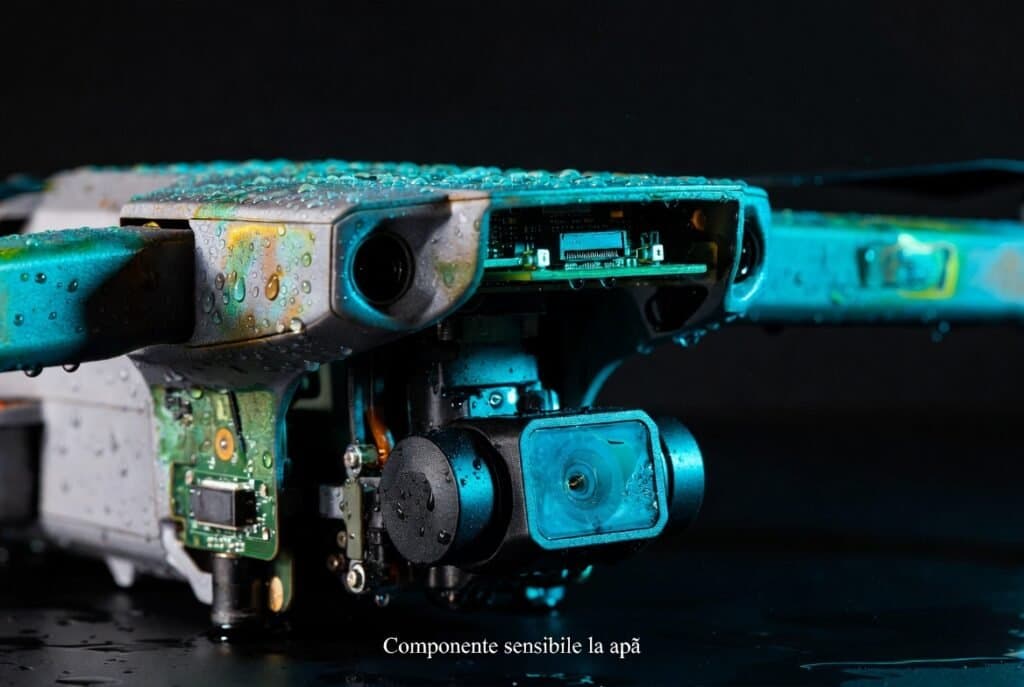
Fresh water (lake, river) causes smaller, slower damage. Salt water (sea) accelerates corrosion — salt eats metal contacts within hours. Most sensitive components: camera, gimbal, flight controller board, ESCs, and LiPo battery.
Good news: if you act fast, oxidation doesn't have time to set in. We've saved drones that spent 30 seconds underwater. If you let them dry on their own, risk increases exponentially.
What to do in the first 5 minutes
These minutes decide whether the drone can be repaired or becomes unusable:
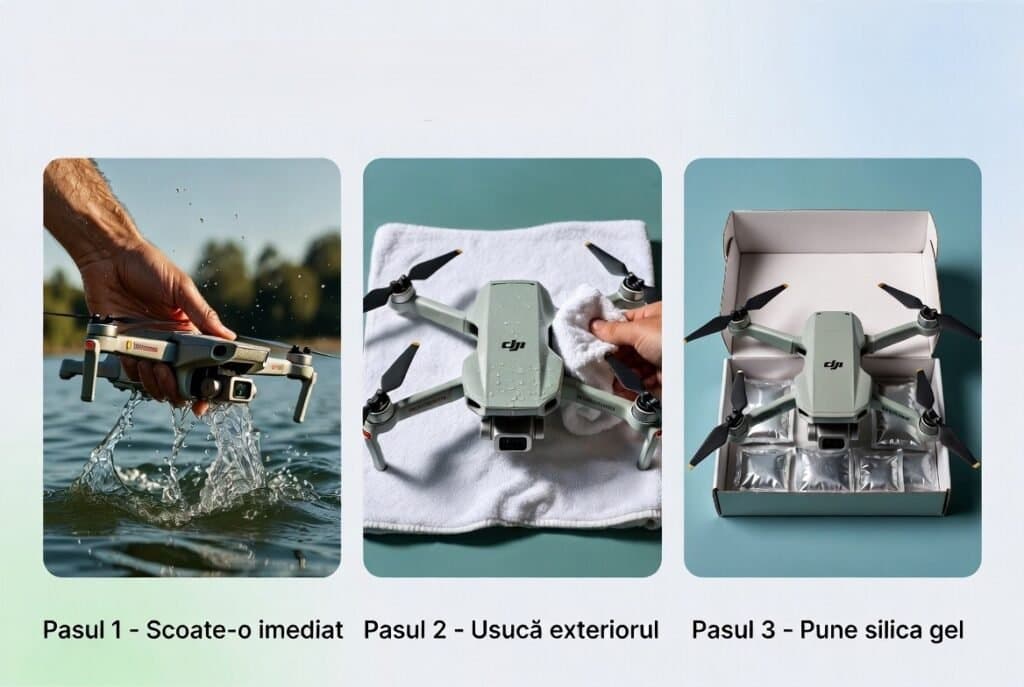
- Remove the drone from water as fast as possible — grab the airframe, not cables.
- Remove the battery immediately — disconnect without powering on, even if wet.
- Shake off excess water — hold the drone motors-down and shake gently 10–15 times.
- If salt water — rinse with distilled or fresh water for 1–2 minutes under a gentle stream.
- Don't power on or test — the interior is still full of water; powering on now destroys electronics.
Proper drying steps
Most pilots get drying wrong. Here's what works:
- Place the drone in an airtight box with silica gel packets — minimum 5–7 days, dry place, no direct sun.
- You can use professional desiccant for faster absorption.
- After 3 days, you can wipe with 99% isopropyl alcohol (IPA) if you carefully open the housing.
Proper drying steps
What you must never do:
- Don't put the drone in rice — it doesn't absorb effectively and leaves particles.
- Don't use a hair dryer, radiator, or direct sun — heat can melt adhesive or create internal condensation.
- Don't put it in an oven or microwave.
- Don't power it on "to see if it works" before a full 7 days.
When it can still be repaired and when it's lost
Most DJI drones (Mini, Air, Mavic, Avata) can be repaired if you act fast. Good signs:
- The drone wasn't underwater more than 1–2 minutes.
- The battery didn't swell.
- No burnt smell after drying.
When it can still be repaired and when it's lost
Components frequently repaired at DroneDoctor: motors and ESCs, flight controller (cleaning + reprogramming), camera and gimbal.
When it's lost: if it spent 24h+ in salt water, the board is fully oxidized, or the battery swelled severely.
How to prevent future accidents
Practical tips and useful accessories:
- Install floats (drone floats) — costs 150–300 lei and prevents most incidents.
- Use obstacle avoidance at maximum near water.
- Check wind forecast and firmware updates.
- Consider DJI Care Refresh — it also covers water damage.
- Practice near water with an older drone before flying new equipment.
Conclusion
Now you know exactly what to do. Don't leave the drone in rice or power it on prematurely — send it to a specialized service. At DroneDoctor we have an ultrasonic chamber and experience with hundreds of post-water cases, with free shipping from Constanța and the Black Sea coast.
Diagnostic is free — you receive an exact quote before any repair.
Need Service?
Send your drone for free