
legal DJI Mavic 4 Pro flight Romania
How to Fly DJI Mavic 4 Pro Legally in Romania — Complete 2026 Guide
Romania drone law 2026: complete guide to legal DJI Mavic 4 Pro flight — UAS registration, A2 certificate, C2 Remote ID, ROMATSA geo-zones, and altitude limits.
· 13 min
Introduction
DJI Mavic 4 Pro is an advanced drone weighing approximately 1063 g, designed for professional photography and filmmaking. Under Romania's 2026 drone legislation, this model is classified as C2 (EU), placing it in the Open category's A2 subcategory under EASA rules.
This means more formalities than sub-250 g models: the operator must register, obtain the A2 pilot certificate, respect minimum distances from people, and use active Remote ID. This guide explains step by step how to fly legally in Romania in 2026 with DJI Mavic 4 Pro.
What rules apply in Romania
Legal framework
Since 1 January 2024, Romania applies EU Regulations 2019/947 and 2019/945. Drone flights are divided into three categories:
- Open — low-risk operations (most recreational and semi-professional flights).
- Specific — medium-risk operations exceeding open conditions; requires authorization or standard scenario.
- Certified — high-risk operations (passenger transport, hazardous goods, etc.), similar to conventional aviation.
DJI Mavic 4 Pro in A2 subcategory (C2)
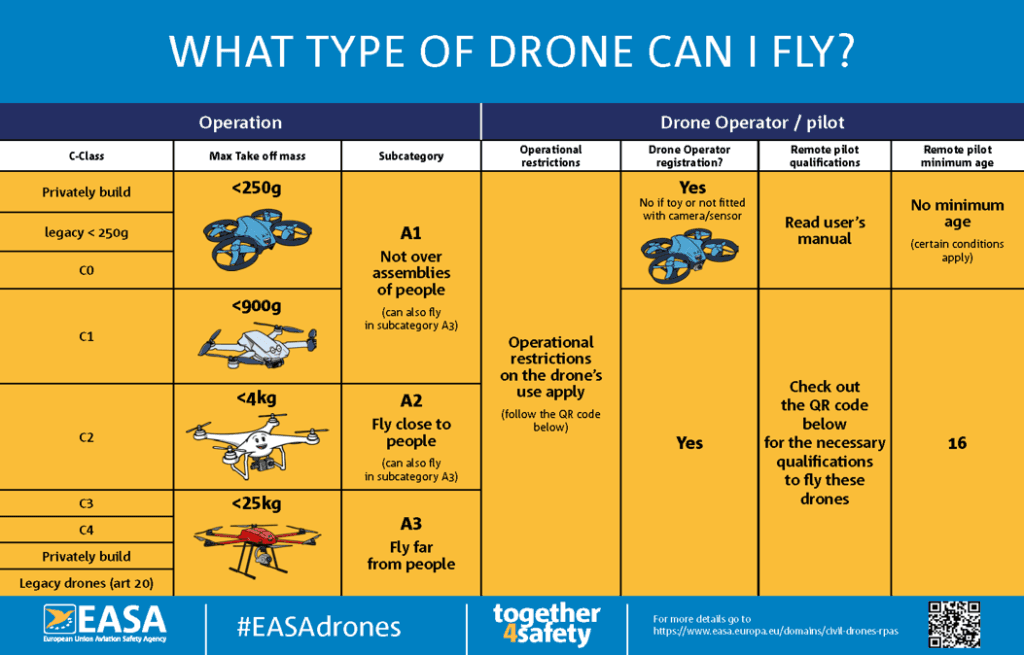
DJI Mavic 4 Pro, with C2 label and weight over 900 g, falls into the Open category, A2 subcategory. For this subcategory, EASA requires the operator to maintain 30 m distance from uninvolved persons, reducible to 5 m only with low-speed mode activated. Maximum permitted altitude remains 120 m.
Even for recreational flights, the pilot must hold the A2 competency certificate and plan flights in safe zones.
Remote ID and other mandatory requirements
EASA requires all C1, C2, and C3 classified drones and drones operated in the Specific category to be equipped with Remote ID. DJI Mavic 4 Pro has integrated Remote ID — the aircraft automatically emits identification messages from takeoff to shutdown. The operator must enter the operator code in the Remote ID module and ensure the system is active. If Remote ID doesn't work, takeoff is prohibited.
Besides Remote ID, the pilot must:
- Register as a UAS operator with the Romanian Civil Aeronautical Authority (AACR).
- Complete the online A1/A3 course and obtain the A2 certificate.
- Read the drone manual and complete practical self-training.
UAS operator registration
Who must register
In Romania, the UAS operator is registered, not the drone. Registration is mandatory if the drone has a camera (Mavic 4 Pro does), weighs over 250 g, or poses risk to people. The operator code obtained is unique and recognized across all EU states.
AACR registration steps
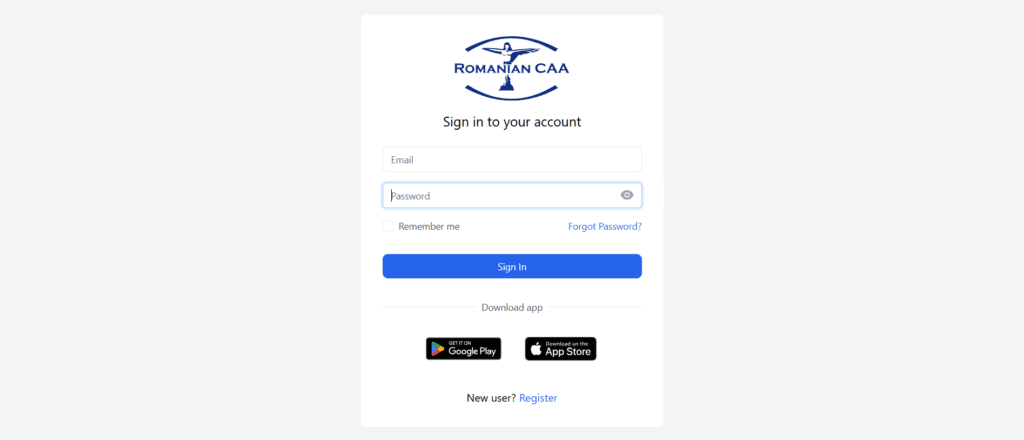
Registration process on the AACR portal (aacr.ro / uas.caa.ro):
- Create an account on the AACR portal — access aacr.ro and register.
- Complete your details (name, contact, address).
- Receive UAS code by email. Affix the code on the drone and enter it in the DJI app (Remote ID).
- Complete the online A1/A3 courses.
- Obtain the A2 certificate: after the course and self-training, take the supplementary exam at AACR.
- Pay any applicable fees.
A2 flight category — strict conditions
Since DJI Mavic 4 Pro has C2 label and weighs ~1063 g, it falls into A2 subcategory. This allows flights in urban areas, but with strict conditions:
- Distance from people: at least 30 m from uninvolved persons. Reducible to 5 m only with low-speed mode.
- Altitude: keep flight below 120 m.
- Registration and certificate: operator must be registered and hold A2 certificate.
- Remote ID: mandatory — module must continuously transmit identification.
A3 subcategory — optional for test flights
For test flights, calibrations, or filming in rural areas, you can choose A3 subcategory. Flights are permitted away from people and buildings, at minimum 150 m from inhabited areas. The drone must not fly over uninvolved persons and must stay below 120 m altitude. A1/A3 certificate is sufficient for A3.
Where you can fly in Romania
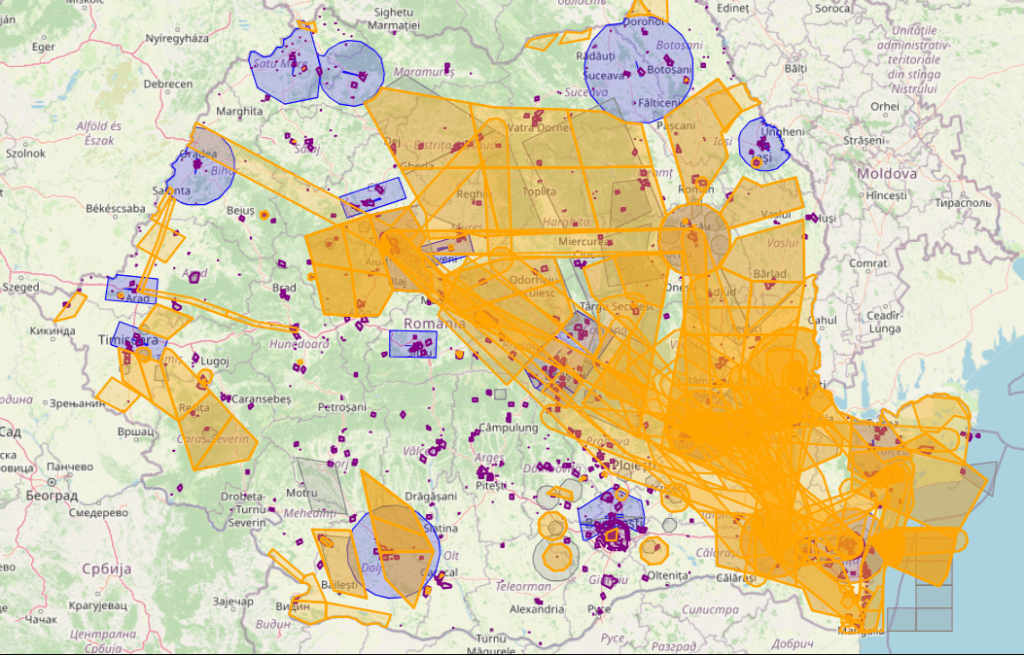
To avoid restrictions, check the official ROMATSA map: flightplan.romatsa.ro/init/drones. It shows controlled zones (CTR), military areas, temporarily restricted zones, and critical infrastructure. Flying without authorization in red or yellow zones is prohibited.
- Select the location on the ROMATSA map.
- Check restrictions (red, yellow, green colors).
- Obtain approvals if necessary (through AACR or local authority).
Legal operating limits
For Mavic 4 Pro, respecting limits is essential:
- Maximum altitude: 120 m.
- Direct visual line of sight (VLOS): keep the drone in your field of view; don't rely only on FPV images.
- Distance from people: 30 m (or 5 m in low-speed mode) for A2; 150 m for A3.
- Distance from built-up areas: minimum 150 m in A3.
- Flights near airports (minimum 8 km) and sensitive industrial zones are prohibited.
Legal flight checklist for DJI Mavic 4 Pro
Check these items before every Mavic 4 Pro takeoff:
- UAS operator registered — UAS code affixed to drone.
- A2 certificate — obtained after A1/A3 course, self-training, and exam.
- Remote ID configured — module continuously transmits operator code.
- ROMATSA map checked — don't fly in restricted zones.
- Altitude set to 120 m.
- Batteries charged and inspected (no swelling).
- Firmware updated — drone, controller, and app.
- Compass/IMU calibration done before flight.
- Favorable weather conditions — avoid strong wind.
- Propellers and arms inspected — no cracks or play.
Test flight after repair
After Service repair, the first Mavic 4 Pro flight must be in A3 subcategory: open rural area, minimum 150 m from people and buildings, initially low altitude (under 30 m). Calibrate IMU, compass, and Hasselblad gimbal before takeoff.
Test stable hover at 3–5 m, verify O4+ transmission, gimbal response, and cameras (wide + tele). Only after a successful verification flight proceed to normal A2 flights.
At DroneDoctor we test every repaired Mavic in our Service before return — gimbal, camera, sensors, arms. You get warranty up to 24 months and free nationwide shipping.
Common mistakes and penalties
Frequently sanctioned errors by authorities:
- Flying without registration — missing UAS code attracts fines.
- Exceeding legal altitude or BVLOS flight without authorization.
- Flying over people or buildings at distances below permitted limits.
- Ignoring geo-zones — flying in prohibited areas (airports, military zones).
- Missing or non-functional Remote ID — for C2 drones, the system is mandatory.
Conclusion
DJI Mavic 4 Pro offers impressive performance but comes with the responsibility of following the law. To fly legally in Romania in 2026, register as a UAS operator, obtain the A2 certificate, configure Remote ID, and fly only in permitted zones.
Minimum distances from people (30 m in A2 and 150 m in A3), maximum altitude of 120 m, and checking the ROMATSA map are key elements. Following the pre-flight checklist protects you from fines and accidents.
Need Service?
Send your drone for free